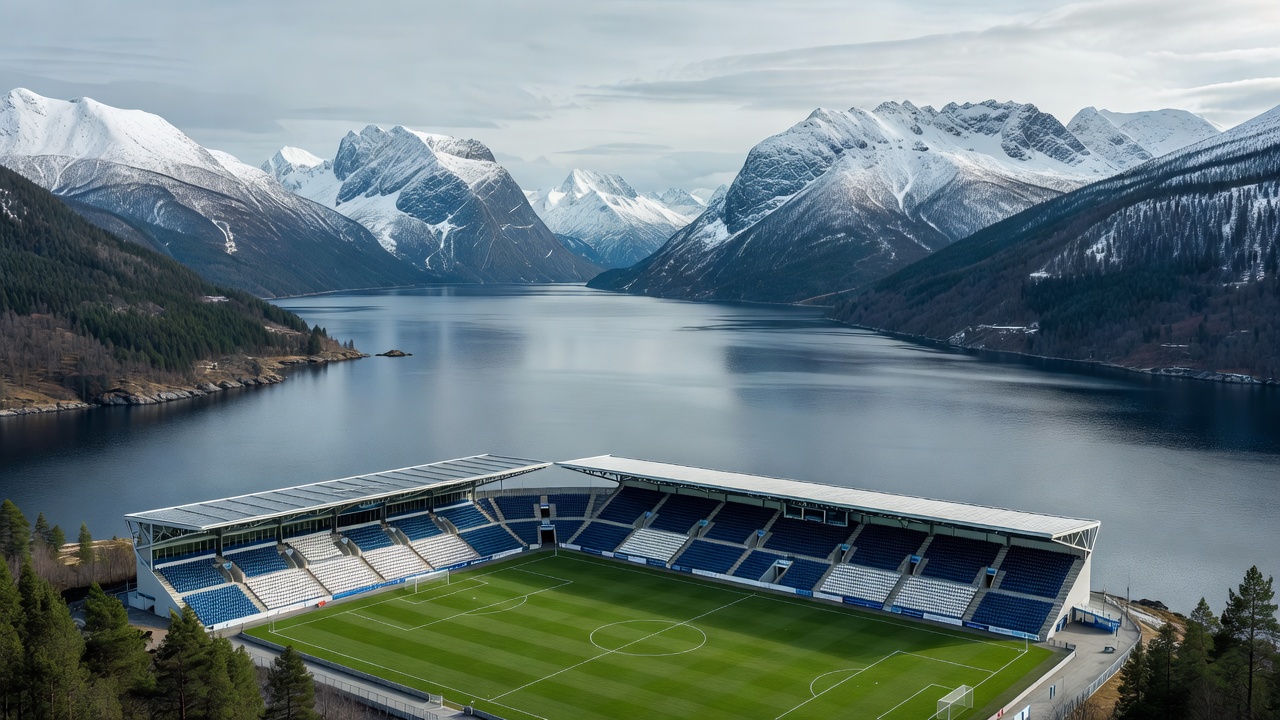
Why Molde are included
Molde FK do not have the same extended Champions League identity as Rosenborg, nor the urban scale of FC Copenhagen. Their value lies elsewhere. Molde have become a recurring Norwegian presence in UEFA competition and offer a useful example of how clear player development, technical football and tactical flexibility can produce competitive European performances.
The club’s setting matters without determining its ceiling. Molde draw from a smaller local market than several rivals, so recruitment and development must work efficiently. Players need a route into the first team, and the club needs to improve them quickly enough to compete while accepting that successful individuals may move on.
Building attacks with purpose
Molde sides are often comfortable constructing attacks from deeper positions. Centre-backs spread, midfielders offer passing angles and full-backs provide width or move inside according to the structure. The aim is not possession for its own sake. Passing is used to draw an opponent forward and create room for quicker players higher up the pitch.
European opponents can disrupt that plan with a faster, better-organised press. Short build-up then becomes a calculation. If Molde persist without clean options, turnovers occur near goal. If they play long too early, the team may lose the technical advantage it is trying to establish. The practical answer is variation: invite pressure when the spacing is right, but use direct passes when the opponent commits too many players.
Transitions and forward movement
Technical build-up is only one part of Molde’s appeal. Their more threatening attacks often include fast movement after a line is broken. Wide forwards can attack the area behind a full-back, while central players arrive around the penalty area rather than waiting in fixed positions.
This creates chances, but it also raises a defensive problem. If several players move beyond the ball, a failed pass can expose the centre. Good rest defence requires defenders and holding midfielders to anticipate the turnover before it occurs. Their distances must be close enough to challenge immediately without standing so high that one pass defeats everyone.
Squad development and turnover
Molde’s model depends on identifying players who can contribute and improve. Domestic knowledge is valuable because adaptation time can be short. Broader recruitment can add different physical and technical qualities, although every new player must learn the team’s movement and defensive responsibilities.
European qualification can affect squad stability. Strong performances increase interest in players, while failure to qualify can alter budgets and opportunities. The club therefore benefits from having replacements who already understand the role rather than waiting until a departure creates an emergency.
European match choices
At home, Molde can use possession and tempo to impose themselves. Their familiar environment and established combinations make it possible to play through pressure. Away ties often demand a different balance. Keeping the ball can quieten a match, but excessive caution may invite sustained pressure. Molde need moments of forward intent so the opponent cannot attack without consequence.
Champions League qualification exposes the side to intense pressing and decisive individual quality. Europa League football can provide more evenly matched possession contests, yet opponents still vary widely. Some defend deep; others force rapid transitions. Molde’s adaptability is therefore more important than allegiance to one shape.
What to watch
- Build-up spacing: check whether the goalkeeper and centre-backs have more than one safe passing route.
- Runs after the first break: look for acceleration once a pressing line has been passed.
- Central protection: observe the positions left behind attacking full-backs.
- Tempo changes: Molde are more dangerous when patient circulation suddenly becomes a direct attack.
Molde’s European profile is not built on pretending resources are equal. It is built on improving players, keeping a coherent style and changing the method when an opponent takes away the preferred route.